Progressive Overload for Strength Gains
Strength Training, Progressive Overload, Dallas Fitness
Progressive Overload: The Science-Backed System for Consistent Strength Gains
Progressive overload is a simple strength training progression system where you gradually increase demand on your muscles over time—by adding weight, reps, sets, or improving form—so your body keeps adapting, getting stronger instead of stalling at the same numbers week after week.
If you’ve been lifting for a while but your numbers haven’t moved, you’re not broken—you’re normal. Most people in commercial gyms around Dallas hit the same weights, in the same way, for months. Then they wonder why they never actually get stronger.
Your body is efficient. Give it the same challenge, it gives you the same result. No reason to adapt. The missing piece is a clear, repeatable system for strength training progression. At The Barbell Club in Old East Dallas on Swiss Avenue, we use progressive overload to turn random workouts into planned strength gains for busy professionals who don’t have time to guess.
What Is Progressive Overload?
The Short Version
Progressive overload means you slowly make your training harder over time in a controlled way. You nudge your body just past what it’s used to, then let it recover and adapt. Repeat that enough times, and “heavy” becomes your new normal. That’s how to get stronger, safely and predictably.
Why Most People Plateau
Most lifters in Dallas, TX either do the exact same workout forever or randomly change everything every week. Neither gives your body a clear message. No pattern, no progression, no reason for your muscles and nervous system to level up. You feel tired, but not actually stronger.
💡 Coach’s note: Feeling wrecked after a workout doesn’t equal progress. Measurable improvement over time does.
The 4 Mechanisms of Progressive Overload (Weight, Reps, Volume, Form Quality)
1. Weight: Adding Load to the Bar
This is the classic version: you add a small amount of weight when you can handle your current load with solid form. Maybe your squat is 135 lb for 3 sets of 5. Next week, you go to 140 lb. Tiny jumps, big long-term payoff. This is the backbone of strength training progression.
2. Reps: Doing More Work with the Same Weight
If the weight can’t go up yet, the reps can. You might stay at 135 lb but move from 3 sets of 5 to 3 sets of 6. Your muscles still see more total work, so they still have to adapt. This is especially useful when life stress or sleep is rough but you still want progress.
3. Volume: More Sets Over the Week
Volume is the total amount of work you do—sets × reps × weight. You can overload by adding an extra set, or by spreading more quality work across the week. For busy Dallas professionals, this lets us match training stress to your schedule without wrecking you for work the next day.
4. Form Quality: Making Each Rep “Heavier”
Better technique actually makes the same weight more challenging to the right muscles. Slower control, full range of motion, tight bracing—your body has to work harder, even if the plates don’t change. This is huge for staying injury-free and building strength that carries over to real life.
Why Progressive Overload Works — The Science (Without the Jargon)
Your body is basically a smart engineer that hates wasted effort. When you keep throwing the same challenge at it, it figures out how to handle that load with less stress. But when you gently bump things up—more weight, more reps, a cleaner rep, or an extra set—it reads that as a signal: “We need to be stronger for next time.” That’s progressive overload in action.
Under the hood, your nervous system learns to fire more muscle fibers, more efficiently, and your muscles themselves get thicker and more capable. You don’t need to understand all the science terms to benefit from it. You just need a simple plan that makes training slightly harder over time, lets you recover, and then repeats. That’s how heavy weight starts to feel “normal,” and that’s how real strength is built.
📌 Key takeaway: No new challenge, no new adaptation. Small, consistent increases beat random brutal workouts every time.
Think of your training like a tiny program that updates your “strength version” each week. Progressive overload is the logic that prevents you from running the same build forever:
current weight = 135 pounds on the bar
target reps = 5
completed reps = 5
if completed reps are equal to target reps: add 5
otherwise keep the same wait until you reach the target reps
That’s all we’re doing in the gym: if you hit the target with good form, we nudge the challenge up. If not, we repeat, refine, and earn the next bump.
How We Apply Progressive Overload at The Barbell Club
1. Structured Programs, Not Random Workouts
Every member at The Barbell Club follows a plan. We map out your main lifts, your starting numbers, and how we’ll progress them week by week. No guessing, no “what should I do today?” Just a clear path to getting stronger in a way that fits your life in Dallas.
2. Tracking System from Day One
You can’t overload what you don’t track. We log your lifts—either on our whiteboards, app, or both—so we always know what you did last time. That’s how we decide whether to add weight, reps, or sets, or to focus on cleaner form that day.
3. Small Classes Capped at 12
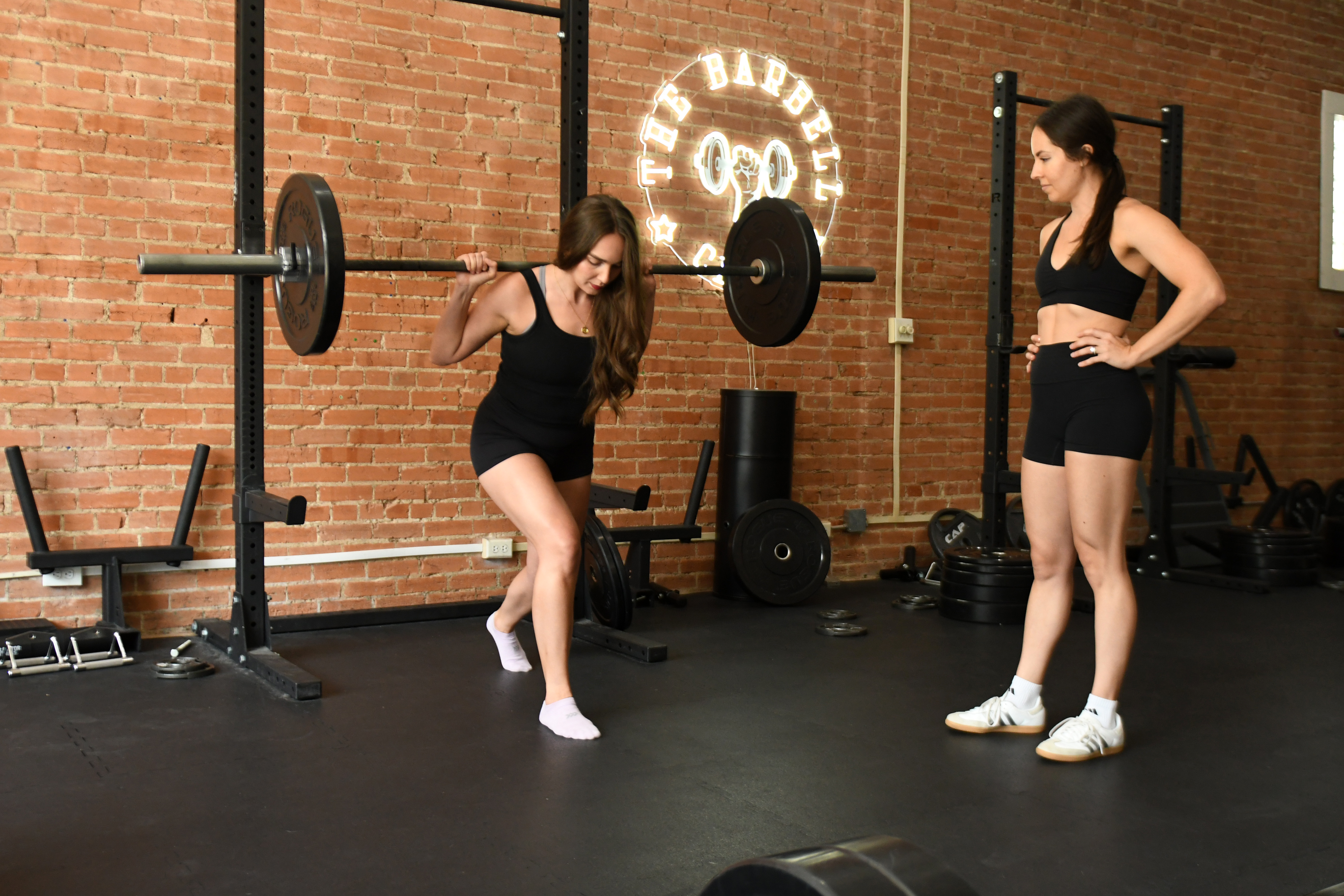
Our strength classes in Old East Dallas are capped at 12 people. That’s on purpose. It gives us enough energy in the room to push you, but enough attention to actually coach you. We watch every set, adjust loads, and call it when your form starts to slip.
4. Coaching That Respects Your Life Outside the Gym
You’re not a full-time athlete. You’re a working professional in Dallas juggling meetings, commutes, and family. We adjust progressive overload based on your stress, sleep, and schedule so you keep moving forward without feeling wrecked for the office the next morning.
When your progress is visible on the board, plateaus stop feeling permanent.
Common Progressive Overload Mistakes to Avoid
Ego lifting: Adding weight faster than your form can handle. Looks impressive, feels risky. We’d rather see you add 5 lb a week for months than jump 30 lb once and tweak your back.
Random programming: New workout every day, no progression, no tracking. Fun for a while, frustrating long-term. Your body needs repetition to adapt and a clear “next step” each week.
Ignoring form: Treating technique as optional. Sloppy reps might move more weight today, but they cap your strength tomorrow. Clean form is the fastest, safest way to get stronger.
Comparison Table: Progressive Overload Methods
Method What Changes Example Best For Add Weight Load on the bar increases Squat 135 lb → 140 lb for 3×5 Building maximal strength efficiently Add Reps Reps per set increase 3×5 bench → 3×6 at same weight When weight jumps feel too big or you’re under-recovered Add Sets (Volume) Total sets per lift increase 3×5 deadlift → 4×5 at same weight Building work capacity and muscle while keeping load steady Improve Form / Tempo Control, range of motion, speed Same weight, 3-second lower on each squat Joint-friendly progress and skill building at any level
Frequently Asked Questions
Can beginners do progressive overload?
Absolutely. Beginners in strength training Dallas-wide are actually the perfect candidates. You adapt quickly, so small, smart increases show up fast. The key is starting with light enough weights to learn form, then letting the numbers climb gradually under a coach’s eye.
How often should I increase weight?
Early on, many lifters can add a little weight every session on big lifts like squats and deadlifts. As you get stronger, that might slow to weekly or even every few weeks. At The Barbell Club, we use your logged numbers and how you feel that day to decide whether to bump weight, reps, or just repeat.
What if I miss a session?
Life happens. If you miss a day, we usually repeat your last successful session instead of jumping ahead. If you miss a full week, we might dial the weight back slightly and rebuild. You don’t lose all your strength in a few days, but we respect your body’s need to ramp back up.
Is progressive overload the same for men and women?
The principles are identical. Muscles and nerves adapt the same way. The differences are usually in starting loads, rate of increase, and recovery needs. We coach women and men across Dallas using the same system, just tuned to each person’s body, training history, and schedule.
Do I have to lift heavy to use progressive overload?
“Heavy” is relative. For some, that’s a 300 lb deadlift; for others, it’s a 45 lb bar moved with perfect control. Progressive overload just means “a bit harder than last time,” not “max out every day.” We meet you where you are and build from there.
Conclusion: Ready to Get Stronger on Purpose?
If your current plan is “do a hard workout and hope,” you’ve already seen where that leads: plateaus, frustration, and the same weights staring back at you. Progressive overload gives you a simple, science-backed roadmap for how to get stronger week after week, even with a busy life in Dallas, TX.
At The Barbell Club on Swiss Avenue in Old East Dallas, we handle the programming, tracking, and coaching. You show up, lift, and watch the numbers climb. Book your free strength class at The Barbell Club. We track your progression from day one. [Book Here]
SEO Title Tag: Progressive Overload Dallas: Science-Backed Strength Training at The Barbell Club
Meta Description: Learn how progressive overload helps Dallas professionals break plateaus and build real strength. Discover The Barbell Club’s small-group, science-backed strength training on Swiss Avenue in Old East Dallas.
Focus Keyword: progressive overload